XTAL BALL
TECHNOLOGIES

Dr. Igor Abramzon, Xtal Ball Technologies , Israel
Introduction.
High precision modern equipment for navigation,
communication and instrumentation demands ultra-stable frequency
reference enabling accurate holdover in GPS-denied conditions. At
the battery supply applications, minimal power consumption of the
reference is another mandatory requirement.
For a long time the chip scale atomic clocks (CSAC) have
proffered unsurpassed junction of highest frequency stability
with less than 120 mW consumption however, at serious lack of the
short-term stability.
Xtal Ball presents now alternative concept of ultra-stable
frequency/time reference built on the internally heated resonator
(IHR) technology. These unique devices incorporate the best
properties of CSACs and high-end conventional OCXOs offering
extraordinary agglutination of “atomic” stability, low phase-
noise, miniature sizes and extremely low power consumption.
Construction of the IHR oscillators
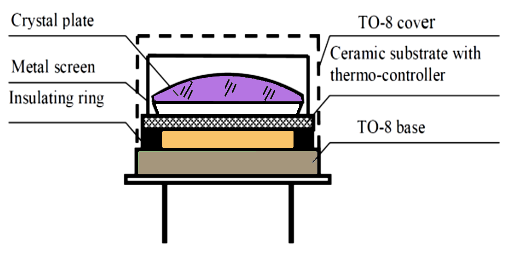
Design of these new oscillators is founded on the IHR structure (Fig.1), where the crystal plate is integrated inside evacuated TO-8 holder with the internal heating system fixing the plate’s temperature at the operation point.
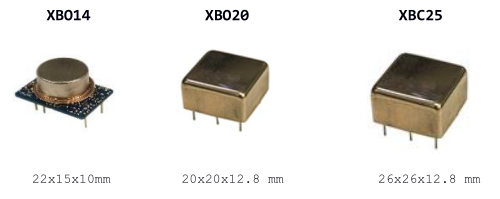
The IHR unit is mounted on an unheated motherboard bearing besides the rest oscillator circuitry. The assembled structure can be hermetically sealed in a standard steel case or used as the DIP14 compatible unpackaged module (Fig. 2).
Very low power consumption of these devices results from excellent vacuum thermal isolation of their internal heated structure from environment. Meantime, achievement of extra-high frequency stability has demanded long intense researches and introduction of crucial innovations in the IHRO construction and technology.
Basic characteristics of novel IHR oscillators
Long-term stability (aging) is a major parameter of the clocks, to a great extend determining holdover of the system operating in autonomous conditions.
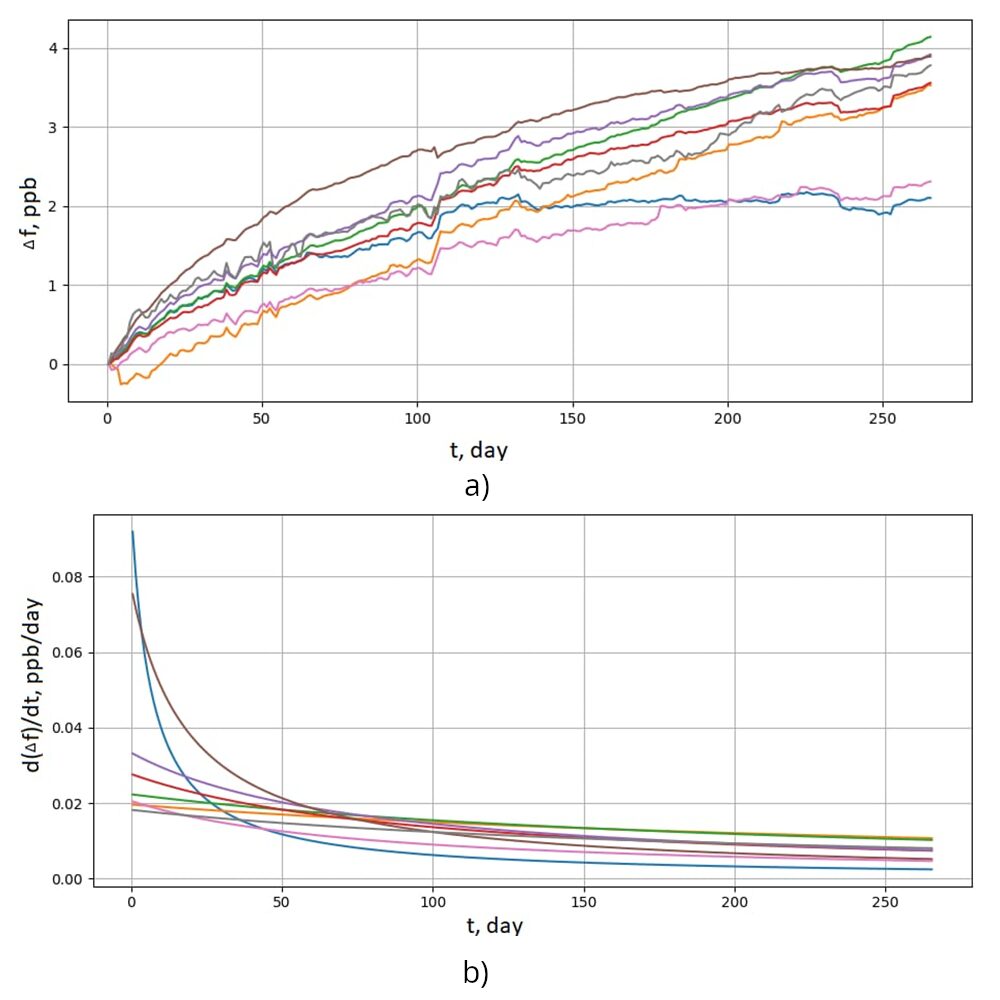
Modern IHROs exhibit aging rate below 1 ppb per month reached after 20 days operation and below 0.02 ppb/day after 60 days operation (Fig. 3). Such extraordinary results exceed the best stability of conventional OCXOs and don’t yield that to the low power atomic clocks.
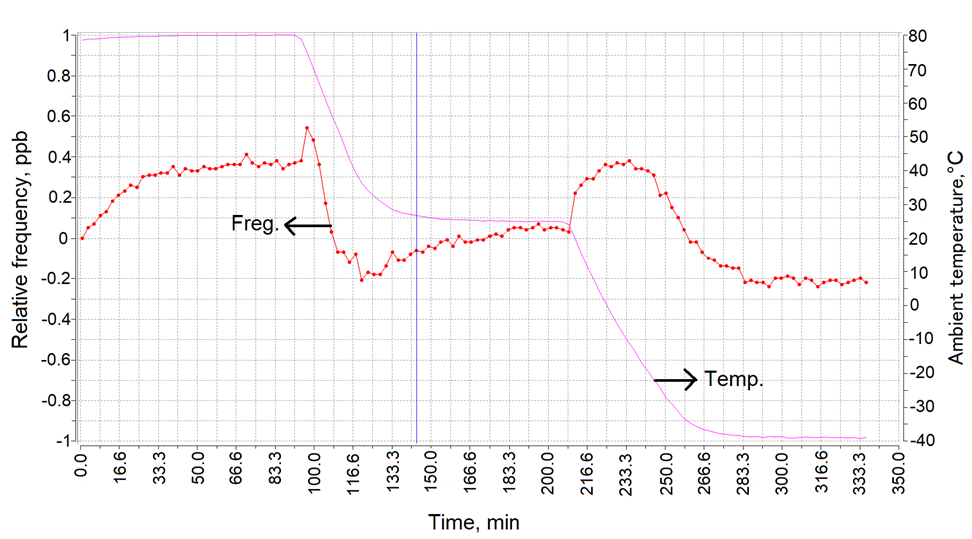
Temperature instability is another crucial parameter providing precision of the reference under severe climate conditions. The IHRO models packaged in steel cases exhibit below ±0.5 ppb frequency deviation over (-40 +85)°C range (Fig. 4), while temperature stability of the DIP14 unpackaged models is about 2 ppb.
Power consumption of the IHROs display obvious dependence on upper temperature of the operation temperature range (table 1) and falls to the record 45 mW for (O +50)°C range.
| Ambient temperature range,°C | 0 +50 | -10 +60 | -30 +70 | -40 +85 |
| Power consumption at 25°C, mW | 45 | 55 | 70 | 85 |
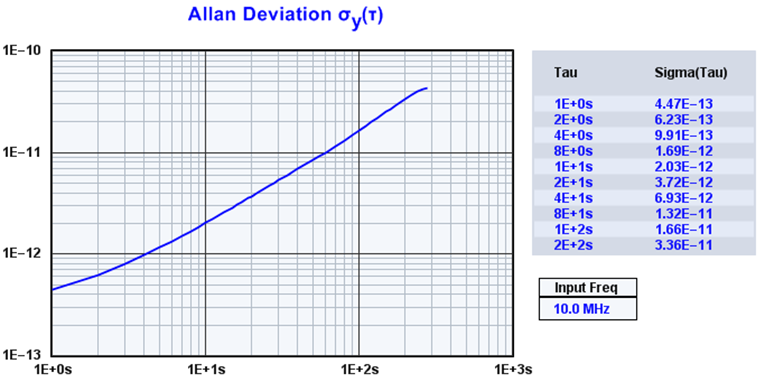
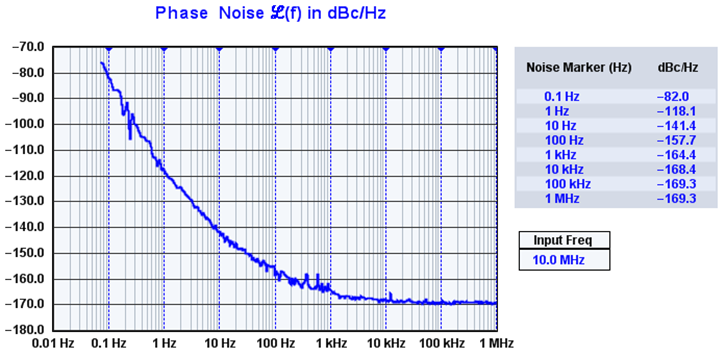
Short-term instability (Allan deviation) and phase-noise of the novel IHROs (fig. 5, 6) are practically even with these parameters of the low-noise conventional OCXOs that was achieved after radical reduction of thermal and flicker noise in the IHR structure and the circuitry.
The IHRO vs. CSAC contest
Considered performances of the new IHRO references are compared in table 2 with two most stable CSAC models (www.microchip.com).
| Performances | XBO20 & XBC25 | SA.65 | SA.45S |
|---|---|---|---|
| Operation frequency, MHz | 10 | ||
| Operation temperature range, °C | -40 +85 | -40 +80 | -10 +70 |
| Temperature stability around 25°C, ppb | ±0.5 | ±0.3 | ±1 |
| Aging (typical), ppb/month | 0.9 | ||
| Allan deviation, τ=1s | 1E-12 | 3E-11** | 3E-10 |
| Power consumption at 25°C, mW | <100 45* |
120 | |
| Package volume, ccm | <9 | 17 | |
As it follows from the data, both the crystal and atomic
references perform close long-term and temperature stability. At
the same time, the IHROs provide drastically lower short-term
instability and phase-noise level at noticeably smaller sizes and
power consumption.
Possessing “atomic” frequency stability at very low Allan
deviation, phase-noise and power consumption the new crystal
references seem ideal alternative to CSACs and high-end
conventional OCXOs at a plenty of modern applications, such as
high-end portable instrumentation, communication, navigation or
ocean seismic geological exploration.
